
Chairperson Masterclass Series 2026 – Leadership Qualities Needed During the Climate Crisis

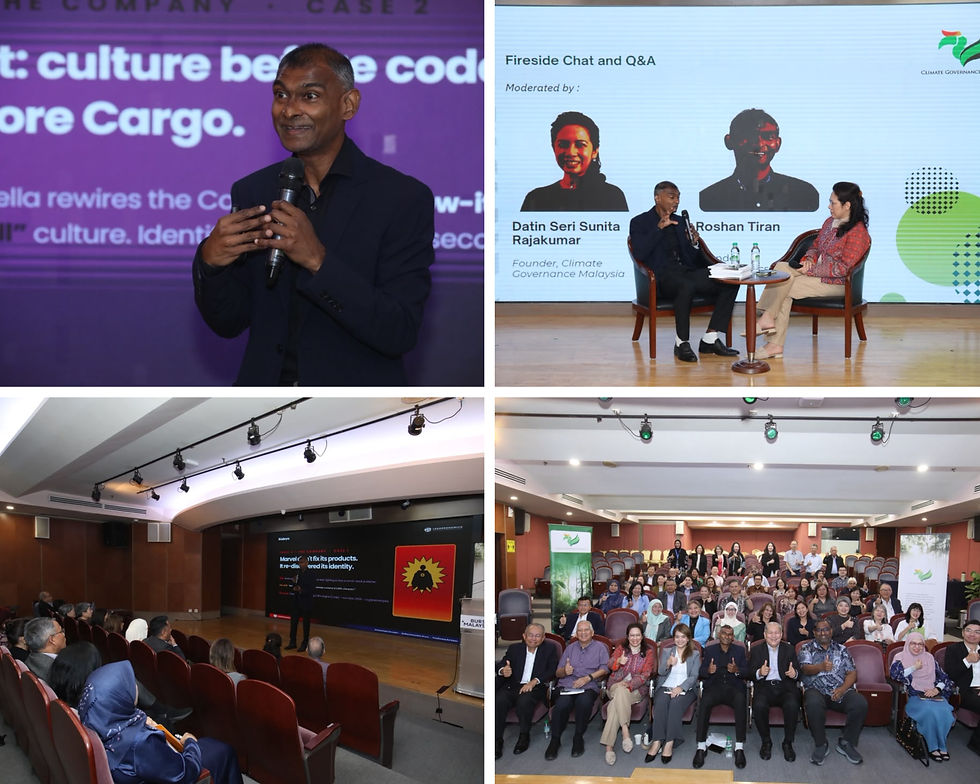
Speaker: Roshan Thiran, Founder and Chief Kuli, Leaderonomics
Moderator: Datin Sri Sunita Rajakumar, Founder, Climate Governance Malaysia
The masterclass examined the leadership qualities required for chairpersons, boards of directors and senior executives to navigate the climate crisis amid technological disruption, economic uncertainty and organisational transformation.
Roshan Thiran emphasis that meaningful organizational transformation begins internally, through changes in leadership behavior, corporate culture, decision-making structures and organizational systems.
Roshan Thiran's central argument is that effective climate transformation begins within an organisation, not through external commitments alone. While many boards already have climate-related information, reporting frameworks, and risk assessments, organisational culture, entrenched practices, ineffective communication, and resistance to change often constrain their ability to act.
Drawing on his experience transforming an underperforming General Electric aviation-engine maintenance operation in Malaysia, Roshan demonstrated how organisational performance can improve when leaders remove structural barriers, empower employees, encourage honest communication and reinforce desired behaviours through consistent practices.
The discussion emphasized that boards must move beyond monitoring climate disclosures and setting sustainability targets. Their responsibility is to create the conditions necessary for management and employees to implement meaningful, long-term changes.
1. Organisational Transformation Begins from Within
Roshan introduced the concept of the organisation's internal climate, the culture, trust, leadership practices, and decision-making environment that determine whether transformation can succeed.
He explained that organisations frequently recognise emerging threats but fail to respond effectively. Referring to companies such as Nokia and Kodak, he highlighted how established organisations can lose competitiveness despite having experienced management teams and access to relevant information.
A central message was that awareness of a problem does not automatically translate into action. Successful transformation requires leaders to address internal assumptions, behaviours and systems that prevent organisations from adapting.
Roshan described transformation through three interconnected elements: the organisation's core, representing its identity and convictions; its code, representing the systems, habits and practices that support those convictions; and its cargo, representing the results produced.
2. Removing Organisational Barriers to Change
Roshan illustrated his argument using GE Engine Services Malaysia as a case study, Roshan described how operational improvements were achieved by addressing organizational inefficiencies and empowering employees. He identified business models, alignment, organisational structures and culture as four interconnected areas requiring attention during transformation.
According to his account, the facility initially required approximately 550 days to complete an engine overhaul, compared with an industry benchmark of around 60–80 days. Through operational restructuring, employee empowerment and recognition of incremental improvements, turnaround time reportedly decreased to approximately 40 days.
He highlighted how celebrating employees' achievements, including improvements in engine disassembly time, encouraged greater participation and strengthened organisational confidence.
The experience informed him that poor organisational performance is not necessarily caused by a lack of employee capability. Instead, employees may be constrained by bureaucracy, rigid procedures, ineffective incentives and a culture that discourages initiative.
Roshan identified four interconnected areas requiring attention during transformation: business models, organisational alignment, structures and systems, and culture.
3. Governing During Periods of Uncertainty
The presentation explored the challenges of leading organisations when established systems are becoming obsolete, but replacement systems have not yet fully developed.
Roshan described contemporary society as experiencing overlapping technological, biological and physical transformations, including artificial intelligence, biotechnology, robotics and digital innovation.
He argued that transitions are rarely immediate or linear. Older and newer technologies, business models and practices often coexist for extended periods, creating uncertainty for organisations and policymakers.
The same principle applies to climate transition. Businesses must continue operating under existing economic conditions while preparing for evolving regulatory expectations, emerging technologies and changing market demands.
Roshan used the transformation of Danish energy company Ørsted from fossil-fuel activities towards renewable energy to illustrate both the opportunities and uncertainties associated with long-term strategic change.
4. Paradoxical Leadership and Difficult Trade-offs
Roshan highlighted the importance of paradoxical leadership, including balancing short-term profitability with long-term sustainability, urgency with patience, and organization with innovation. Leaders must manage these tensions rather than treating them as mutually exclusive choices.
For corporate boards, this includes balancing immediate financial performance with long-term sustainability, maintaining urgency while exercising patience, challenging management while supporting its execution, and preserving operational stability while encouraging innovation.
He argued that effective leaders should not necessarily choose one priority at the expense of another. Instead, they must recognize these tensions as normal features of organizational transformation and develop the judgment needed to manage them.
This approach is particularly relevant to climate governance, where investments may involve substantial upfront costs while delivering environmental, operational and financial benefits over longer periods.
5. Psychological Safety, Candour and the Role of the Chairperson
A major theme was the importance of establishing a boardroom culture in which difficult questions, dissenting views and unfavorable information can be raised without fear.
Roshan argued that organizational failures can occur when management hesitates to communicate problems to senior leadership. Without an accurate understanding of operational realities, boards risk making decisions based on incomplete or overly optimistic information.
He identified candour as a fundamental governance control and emphasized the chairperson's responsibility for setting the tone of boardroom discussions.
The chairperson should ensure that directors can challenge assumptions, management can communicate emerging risks before they become crises, and organizational concerns are addressed constructively.
The discussion emphasized the importance of enabling employees and management to communicate unfavorable information without fear. Roshan warned that when bad news is discouraged, boards may make decisions based on incomplete information. Chairpersons therefore play a critical role in encouraging constructive challenge and honest discussion.
6. Embedding Climate Action into Organisational Systems
During the moderated discussion, Datin Sri Sunita Rajakumar raised concerns about the difficulty of translating growing climate awareness into organization-wide action. Roshan explained that communication alone is insufficient. Sustainability priorities must be incorporated into organizational procedures, incentives, employee responsibilities and recurring practices.
She observed that climate-related reporting, disclosures and regulatory expectations have become more familiar to Malaysian corporations. However, ensuring that climate priorities are understood and implemented throughout an organisation remains a significant challenge.
Roshan responded that communication alone is insufficient. Strategic objectives can become distorted as messages pass from the board to senior management, middle management and frontline employees.
He recommended embedding sustainability priorities into business processes, operational responsibilities, employee experience and organisational routines.
Rather than relying solely on periodic awareness programmes, organisations should establish practical mechanisms that make sustainable practices part of everyday decision-making.
7. Managing Organisational Friction
Roshan introduced the concept of friction management, explaining that organizational procedures can either support or obstruct desirable behaviors.
Roshan described how procedures and approval requirements can either support or obstruct transformation. Appropriate controls are necessary for safety and compliance, but unnecessary bureaucracy can delay decisions and discourage innovation. Leaders should remove friction from desirable behaviors while maintaining safeguards against unacceptable risks.
He argued that not all bureaucracy is inherently harmful. Certain controls are necessary to maintain safety, accountability, and regulatory compliance. However, excessive approval requirements and administrative barriers can discourage innovation and prevent employees from addressing problems promptly.
Effective leadership therefore requires organizations to introduce appropriate controls where risks must be managed while removing unnecessary obstacles to communication, learning and improvement.
In climate governance, this means making sustainable practices easier to implement while maintaining appropriate oversight of environmental and operational risks.
8. Moving from Reactive to Forward-Looking Governance
The masterclass highlighted the limitations of relying exclusively on historical performance indicators. Roshan encouraged boards to consider leading indicators, frequent organizational feedback, and emerging risks to support more responsive decision-making.
Roshan encouraged boards to distinguish between lagging indicators, which measure outcomes that have already occurred, and leading indicators, which can help identify emerging risks and future developments.
He described how technology could enable organisations to collect more frequent employee feedback, monitor changes in organisational culture and improve management responsiveness. During the discussion, the moderator questioned how organisations could identify meaningful climate indicators when predictive capabilities and relevant data remain limited.
Roshan suggested that the challenge may not always be insufficient information. In some circumstances, organisations already understand the risks but remain unable or unwilling to act because of internal constraints. He encouraged leaders to examine the organisational systems, assumptions and incentives that may be preventing necessary decisions.
9. Institutionalizing Change through Organisational Rituals
Roshan emphasised that organisational culture is reinforced through repeated experiences and practices, rather than statements of corporate values alone.
He encouraged boards to reconsider established routines, including the order in which issues are discussed, the frequency of performance reviews and the mechanisms through which employees provide feedback.
Examples of proposed boardroom practices included prioritising bad news during meetings, encouraging alternative perspectives and periodically questioning whether existing strategies would be maintained by an entirely new board.
These practices are intended to reduce complacency, improve accountability and encourage continuous adaptation.
Roshan summarised the process through three actions: diagnose, redesign and ritualise. Organisations should first identify the barriers preventing change, redesign the relevant systems and establish recurring practices that reinforce the intended behaviours.
10. Board Accountability for Long-Term Climate Resilience
The discussion reinforced the distinction between management's responsibility for executing strategy and the board's responsibility for establishing the conditions in which effective execution becomes possible.
Roshan characterised the chairperson as a Chief Condition Officer, responsible for shaping an environment of clarity, accountability, candour and courage. He argued that successful boards should ensure that organisational priorities are understood at every level, employees can raise concerns without unnecessary obstacles, and management remains willing to reconsider established practices.
For climate governance, this requires sustainability to become an integral part of organisational strategy and culture rather than a separate reporting or compliance exercise.
Roshan proposed that boards reconsider established practices, including meeting structures, performance reviews, and employee feedback mechanisms. He emphasized three actions: diagnose, redesign, and ritualize, to ensure that organizational change becomes part of routine operations.
Conclusion
The masterclass highlighted that effective leadership during the climate crisis requires more than technical knowledge, regulatory compliance, and ambitious sustainability commitments. It requires organizations to confront internal barriers, develop adaptive cultures and empower employees to participate in meaningful transformation.
Roshan Thiran's presentation demonstrated that organizational change depends on the interaction between leadership, culture, structures, incentives and everyday behaviors. His experience suggested that significant improvements are possible when organizations create environments that enable individuals to perform effectively.
Roshan Thiran characterized the chairperson as a Chief Condition Officer, responsible for establishing the clarity, accountability, candour and courage necessary for organizational transformation.
The overarching message was that boards must take responsibility not only for the strategies they approve but also for the organizational conditions that determine whether those strategies succeed.
For Malaysian corporations, this means moving from climate awareness towards sustained implementation, embedding sustainability within business decisions and strengthening the organizational resilience needed to navigate an uncertain future.
Watch Recording


Comments