.png)


A MALAYSIA-NETHERLANDS DIALOGUE:
PRIVATE SECTOR APPROACHES TO SUSTAINABILITY
The Dutch Webinar Series is a joint initiative by Climate Governance Malaysia and the Embassy of the Kingdom of the Netherlands, providing an open platform for dialogue and knowledge exchange on sustainability and climate-related business practices.
The series brings together business leaders, policymakers, practitioners, and experts to share practical insights on integrating sustainability into corporate strategy, operations, and governance. All sessions are free and open to the public, with recordings and post-event resources made available to support continued learning. Over time, the series aims to broaden engagement across the ASEAN region.
Each session would features an embassy video, opening remarks by CGM and the Embassy, a keynote presentation, a panel discussion, a moderated live Q&A session, and a closing wrap-up highlighting three key takeaways.
What to Expect
-
Expert keynote presentations/ speech and moderated discussions
-
Practical insights into implementation challenges, trade-offs, and competitive advantage
Cross-border perspectives with local relevance -
Multi-stakeholder dialogue across business, finance, and policy
Learning Beyond the Live Session
-
Free and open to the public
-
Session recordings available after each webinar
-
Recap blogs and curated slides for continued learning
Who Should Attend
-
Corporate leaders, sustainability professionals, policymakers, legal practitioners, financiers, researchers, and students interested in practical, private-sector-led sustainability solutions.
*You’ll receive an email update as soon as the webinar details and dates are confirmed — stay tuned!
Waste-to-Energy: Scaling Biogas & Circular
Bioeconomy
30 September 2026
High-strength organic waste and effluent streams, including Palm Oil Mill Effluent (POME), livestock waste, and agro-industrial byproducts, represent a significant yet underutilised resource. Conventional waste management systems can also result in the release of potent greenhouse gas emissions.
This session explores the transition from basic waste treatment towards high-value bioenergy recovery, drawing on European best practices and Dutch technological innovation. The discussion will examine the operational, financial, and regulatory pathways needed to scale advanced anaerobic digestion, biogas capture, and waste valorisation.
The session will offer practical insights for board members, mill operators, and energy leaders on unlocking the commercial and environmental value of organic waste while supporting the broader energy transition and industrial decarbonisation agenda.
Panelists:
Harmen Dekker, CEO, European Biogass Association
Cynthia Ong, Board Chair & Chief Executive Facilitator (To Be Confirmed)
Moderators: [ ]
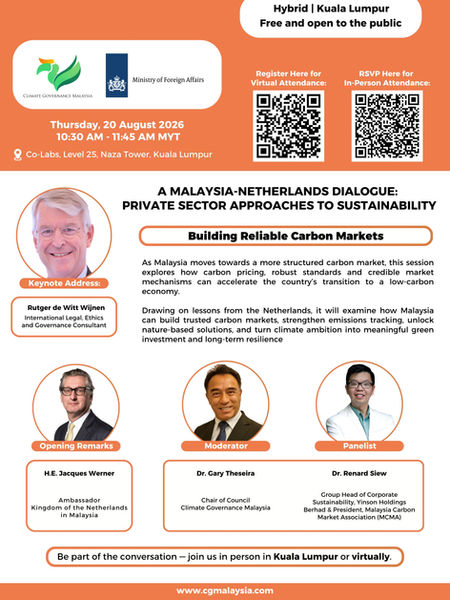
Building Reliable Carbon Market
Malaysia operated as a nascent carbon market that was actively transitioning from a foundational phase into a structured national ecosystem. Whilst it stood as a voluntary carbon market, the Malaysian Government had indicated a clear intent to price carbon to meet international climate pledges and fund domestic green investment. However, the absence of a rigorous greenhouse gas emissions baseline, uncertainty over which industrial sectors to prioritise, and the relocation of high-pollution “dirty industries” into Malaysia emphasised the urgent need to set clearer milestones beyond the broad “net zero by 2050” commitment.
Drawing on lessons from pioneering policy and carbon market integration in Dutch sectors, this session unpacked the drivers of implementing carbon pricing mechanisms in Malaysia by addressing: global standards and methodologies for generating reliable carbon markets; the realities of moving away from voluntary towards mandatory compliance; structural challenges in establishing reliable tracking systems to prevent double counting; and the conditions needed to deploy nature-based solutions effectively.
Past Sessions
Sustainable Dairy Farming
.png)
Dairy products provide essential nutrients for many people around the world. However, the dairy industry is also a significant user of land, water, and energy, contributing approximately 2.7% of global greenhouse gas emissions. To reduce the industry's environmental impact, a transition towards sustainable dairy farming is necessary.
With the Malaysian dairy sector projected to grow by 7.5% between 2025 and 2032, the session highlighted the importance of implementing sustainable practices to support the industry's long-term development.
Drawing on lessons from the Dutch dairy sector, the discussion unpacked the barriers and drivers influencing the adoption of sustainable dairy farming practices in Malaysia. It explored sustainable best practices from the Netherlands, the latest technologies, financing schemes, and operational approaches, as well as the challenges and enabling conditions for implementation in Malaysia. The session also examined key enablers such as finance, policy, behavioural change, institutional capacity, and technology and innovation.
Palm Waste as
Valuable Biomass

Malaysia is one of the largest producers of palm oil in the world, contributing significantly to the country’s economy but also maintaining an industry which generates a lot of waste. Palm oil processing activities yield only 10% palm oil and palm kernel oil, while the remaining 90% remains in the form of biomass or waste. This biomass represents a substantial and largely untapped resource for biofuel production. Global demand for vegetable oils is projected to increase by 46% by 2050, generating even more biomass.
This session explored the potential of palm waste as a resource for biofuel production, highlighting key challenges and opportunities. Discussions centered on:
-
The true potential of palm waste as a viable biofuel resource.
-
The enabling conditions required to effectively scale palm waste utilization.
-
The primary challenges and barriers to scaling palm waste as a mainstream biofuel.
Strategies Behind
Climate Lawsuits
.jpg)
Climate litigation has increasingly been recognised as a powerful tool for advancing climate action by enforcing accountability on governments and corporations, driving policy reforms, and setting legal precedents that amplify broader societal pressure for change. This strategy is now being pursued across more countries than ever before.
In the lead-up to CGM’s Climate and Law Conference, this webinar session unpacked how climate litigation can focus attention within the legal system to combat climate change. Contributors discussed global trends in climate litigation and examined several key cases that have inspired proceedings worldwide.
The session explored several key questions, including:
-
The potential of judicial intervention as a pathway to emissions reduction.
-
The wider socio-political impacts of climate change litigation.
-
How climate litigation leverages existing legal frameworks to combat climate change, including the strategic processes involved.
-
The implications of these cases for Malaysia in developing successful legal strategies.
Protecting Critical Freshwater Resources

Water is a critical resource for both human health and wellbeing, as well as economic production. However, due to over-extraction, climate change, and pollution, the world’s freshwater resources are under increasing pressure. In Malaysia, rising demand alongside diminishing water supply has intensified competition among water users. Businesses that rely on freshwater for their operations are increasingly exploring ways to go off-grid, improve water efficiency, and restore water basins to strengthen their water security.
This session explored private sector approaches to protecting freshwater resources, with discussions centred on:
-
-
Initiatives undertaken by companies to enhance water stewardship
-
The enabling conditions that supported these initiatives
-
Desired enabling conditions, including finance, policy, behavioural change, institutional capacity, as well as technology and innovation
-
Key lessons learned that could benefit other businesses
-