
Directors' Masterclass Series
2026
Climate Governance Malaysia's flagship Directors’ Masterclass Series continues its fourth year of empowering directors and senior executives with the knowledge and perspectives needed to navigate climate, nature and sustainability-related risks and opportunities.
The 2026 edition has successfully concluded, bringing together directors, senior leaders and industry experts for focused discussions on key boardroom priorities, including climate-related regulations, director responsibilities, sustainability governance and emerging opportunities in the transition to a more resilient economy.
Through expert-led masterclasses, practical insights and meaningful peer exchanges, the series supports directors in strengthening board oversight, making informed decisions and translating complex sustainability challenges into effective governance strategies.
Stay connected with Climate Governance Malaysia for updates on future editions and upcoming programmes.
PAST SESSIONS

As climate-related expectations, disclosure requirements and regulatory scrutiny continued to evolve, directors faced increasing responsibilities and potential liability for how their organisations identified, managed and disclosed climate-related risks. The masterclass examined the intersection of climate risk, legal obligations, fiduciary duties and board oversight, highlighting the legal, regulatory and reputational implications of climate-related decision-making.
The session explored how directors could strengthen governance practices, enhance accountability and navigate evolving expectations with greater confidence. Drawing on practical insights from climate law and sustainability risk governance, the discussion highlighted the importance of moving beyond passive oversight towards more informed decision-making and fulfilling board responsibilities in the climate era.

As sustainability reporting, climate-related risks, transition planning and sustainable finance became increasingly important to corporate decision-making, directors faced growing expectations to strengthen oversight and ensure that sustainability considerations were properly integrated into boardroom discussions. This masterclass examined the practical questions directors should ask when overseeing sustainability matters, moving beyond reporting frameworks to focus on disclosure credibility, climate risk and transition readiness.
The session explored how directors could strengthen sustainability oversight, assess climate-related risks and transition plans, and make informed decisions around sustainable finance. It also considered practical approaches to strengthening disclosure credibility and assurance readiness, helping boards fulfil their fiduciary responsibilities while supporting long-term organisational resilience.

As organisations navigate the uncertainty and competing priorities of the climate transition, chairpersons and boards play a critical role in aligning strategy, leadership and organisational culture to build long-term resilience. Led by Roshan Tiran, Founder and Chief “Kuli” of Leaderonomics, the Chairperson Masterclass explored the leadership qualities needed to guide organisations through disruption, manage difficult trade-offs and strengthen boardroom decision-making. The session offered practical perspectives on assessing organisational readiness, fostering high-performance cultures and translating climate commitments into enterprise resilience and sustainable long-term value.

The session offered directors practical perspectives on identifying weak signals, assessing interconnected risks and strengthening organisational resilience in an uncertain environment. It also explored how boards could prepare for multiple future scenarios and make more forward-looking, adaptive decisions as climate, geopolitical and emerging risks continued to evolve.

As the climate transition reshapes markets, business models and investment priorities, boards are increasingly expected to look beyond immediate risks and consider how their organisations can remain resilient and competitive through structural change. Led by Ian Monroe, President & Chief Investment Officer of Etho Capital, the masterclass explored the strategic questions directors should be asking as climate-related risks and opportunities increasingly influence corporate decision-making and long-term value creation. The session provided practical perspectives on how boards can challenge strategic assumptions, strengthen oversight and support business transformation, while offering directors a board-level lens on navigating the climate transition and positioning their organisations for long-term resilience and sustainable growth.
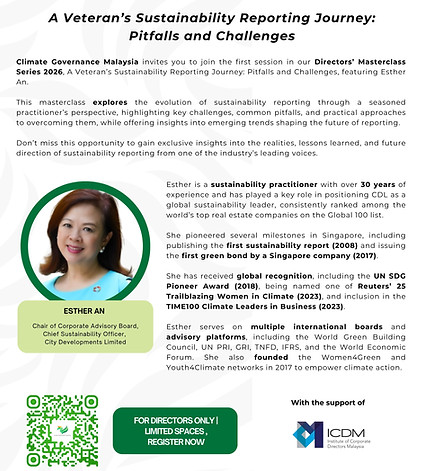
Dive into the evolving world of sustainability reporting with Esther An, a seasoned sustainability leader with over 30 years steering reporting strategies for multinational corporations and advising boards on global standards like ISSB and TCFD. Through her practitioner's lens, this masterclass unpacks key challenges, sidesteps common pitfalls, and arms you with practical approaches to excel—while spotlighting emerging trends set to redefine reporting in 2026 and beyond.

Climate litigation is rapidly emerging as one of the most significant governance risks facing boards and senior executives worldwide. As regulatory expectations evolve and stakeholder scrutiny intensifies, directors are increasingly expected to understand how climate-related legal risks can affect corporate strategy, fiduciary duties, disclosure obligations, and long-term resilience. In this session, Kiu Jia Yaw explores the growing landscape of climate litigation, drawing on recent developments and practical implications for boards and organisational leadership.