
AI in the Boardroom: Balancing Risk Oversight with Value Creation in the Malaysian Context

12 October 2026
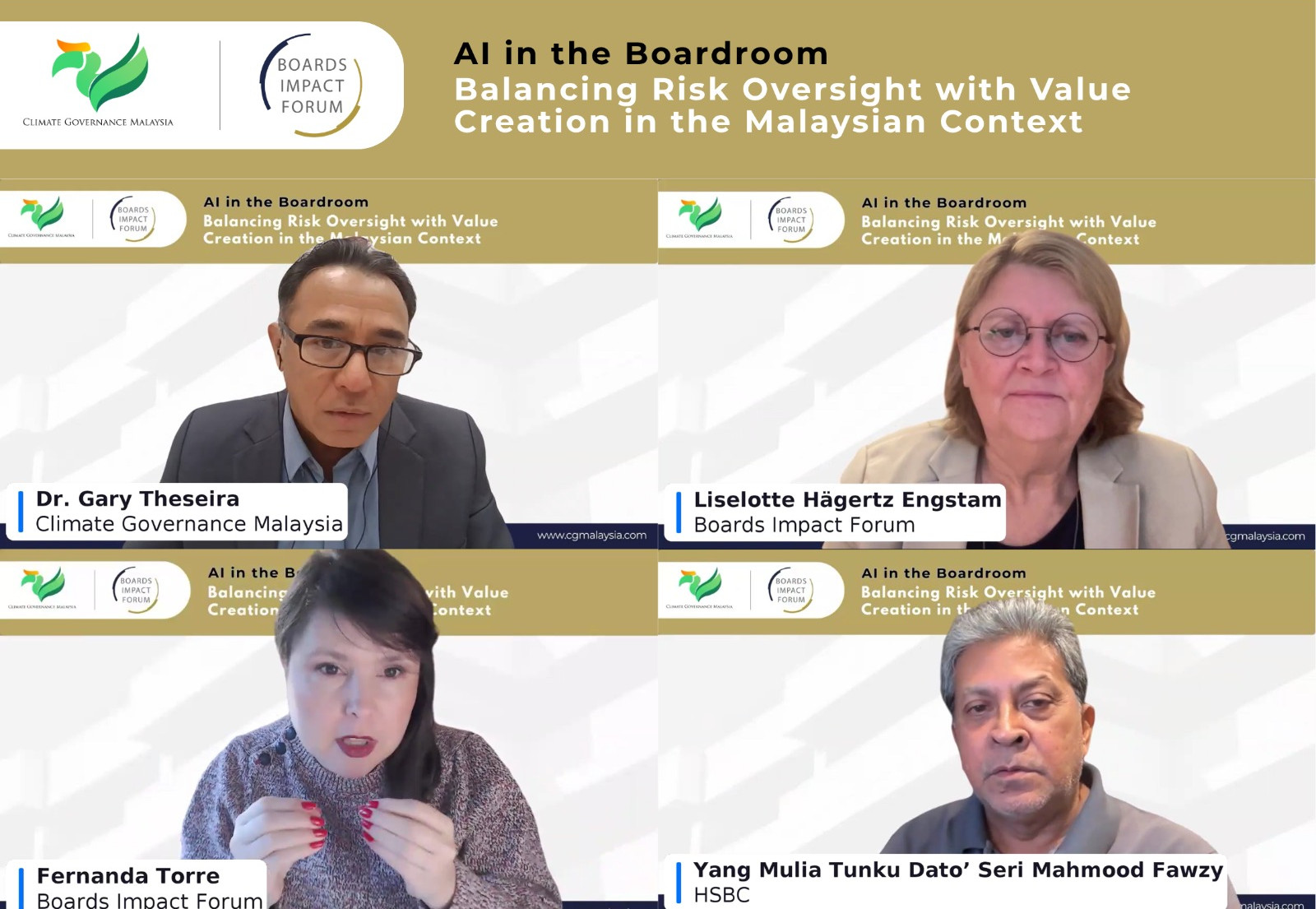
Opening remarks by:
Dr. Gary Theseira, Chair of the Council, Climate Governance Malaysia (CGM)
Speakers:
Liselotte Hägertz Engstam, Chair, Boards Impact Forum
Fernanda Torre, COO, Boards Impact Forum
Yang Mulia Tunku Dato Seri Mahmood Fawzy, Senior Independent Non-Executive Director and Risk Committee Chair of HSBC
Organised by Climate Governance Malaysia (CGM) in collaboration with Boards Impact Forum, the webinar explored how corporate boards can navigate the rapid adoption of artificial intelligence (AI) while balancing effective risk oversight with innovation and long-term value creation. The discussions highlighted AI’s growing implications for corporate governance, business transformation, workforce development, cybersecurity and sustainability, underscoring the need for boards to strengthen their AI capabilities and provide responsible strategic leadership.
In his opening remarks, Dr. Gary Theseira highlighted AI’s expanding use across education, government, research and business, recognising its potential to support tasks such as summarisation, analysis, visualisation and synthesis. He also acknowledged the risks associated with its use and development, particularly concerning algorithmic accountability, data ethics and cybersecurity. He emphasised the importance of balancing fiduciary responsibilities with strategic AI adoption to ensure that organisations can harness its benefits while managing emerging risks.
Liselotte Hägertz Engstam emphasised that boards must navigate increasingly interconnected challenges, including geopolitics, AI, cybersecurity, demographic shifts and climate change. Citing McKinsey research, she noted that while 89% of organisations use AI in at least one business function, only 44% have begun scaling it enterprise-wide, and 37% report contributions to operating profit. Realising AI’s potential requires organisations to redesign workflows, decision-making processes and business models, while addressing the energy, environmental and geopolitical implications of AI infrastructure and the governance challenges posed by autonomous AI agents.
She highlighted growing investor expectations for boards to demonstrate AI competence, provide strategic direction and ensure accountability for AI-related risks and societal impacts. Effective oversight requires three dynamic capabilities: sensing emerging trends and risks, pivoting strategies in response to change, and aligning resources with future opportunities while maintaining existing operations. She concluded that AI governance must extend beyond compliance and risk management, with boards actively shaping AI strategy to strengthen innovation, workforce readiness, organisational resilience and long-term sustainable value creation.
Fernanda Torre presented research on AI leadership for corporate boards, developed since 2018 and informing AI Leadership for Corporate Boards, a practical guide supported by Sweden’s innovation agency, Vinnova. She introduced the Boards for AI Strategic Leadership Framework, which emphasises board accountability, clearly defined roles, relevant competencies and effective governance structures. The framework outlines two complementary responsibilities: guiding AI capabilities through data strategy, innovation and business transformation, and supervising AI capabilities through regulatory compliance, ethical AI, cybersecurity and organisational resilience.
Fernanda stressed that boards must address AI risks across business ecosystems, including vulnerabilities involving suppliers and partners, while considering workforce transformation, societal impacts and AI’s environmental footprint. She encouraged directors to evaluate smaller, task-specific or locally operated AI models as potentially more cost-effective and sustainable alternatives, and introduced a matrix of guiding questions to assess AI maturity and identify priorities. She concluded that effective AI governance requires continuous learning and proactive strategic leadership, balancing innovation with accountability, risk oversight and sustainability.
The panel discussion, featuring Liselotte Hägertz Engstam, Fernanda Torre and Yang Mulia Tunku Dato’ Seri Mahmood Fawzy, explored how boards can balance AI risk oversight with innovation and long-term value creation. Liselotte emphasised that directors must retain strategic responsibility for AI governance rather than delegating it entirely to technology executives, while working closely with technical leaders to understand emerging risks and business implications. Fernanda reinforced the need for multidisciplinary expertise and continuous board education, ensuring that AI governance addresses ethical, organisational and commercial considerations. Tunku discussed the relevance of Bank Negara Malaysia’s AI-related guidance as a voluntary reference for organisations outside the financial sector, noting that regulatory expectations vary across industries.
The panellists examined risks associated with autonomous AI agents, including unpredictable behaviour, unclear permissions and inadequate safeguards. Liselotte advocated maintaining an inventory of AI applications and agents with clearly assigned accountability, while Fernanda highlighted the importance of external expertise and ongoing learning. Tunku underscored the role of independent assurance, internal audits and technology-enabled monitoring in strengthening cybersecurity, compliance and stakeholder confidence. The discussion also explored AI’s implications for sustainability, with Fernanda highlighting the cost, energy consumption and digital-sovereignty concerns associated with large AI models, and Liselotte encouraging boards to direct investments towards measurable environmental and social benefits, including applications in agriculture and resource efficiency. In closing, Fernanda emphasised board alignment, while Tunku highlighted the need for trust, security, effective governance and workforce reskilling as AI transforms business processes, production and consumption. Overall, the panellists stressed that boards must combine strategic leadership, clear accountability and responsible resource allocation to ensure AI adoption delivers sustainable, long-term value.
The webinar underscored that effective AI governance requires boards to balance strategic leadership, risk oversight and responsible innovation. Key priorities include strengthening board-level AI competence, establishing clear accountability, integrating AI into core business operations, and maintaining robust cybersecurity and assurance mechanisms. Boards must also address workforce readiness, energy consumption and AI’s wider environmental and social impacts. Through continuous learning, forward-looking strategies and responsible resource allocation, organisations can harness AI to strengthen resilience, support sustainable transformation and create long-term value.
Watch Recording


Comments