.png)
Sustainable Dairy Farming

Date: 8 Une 2026
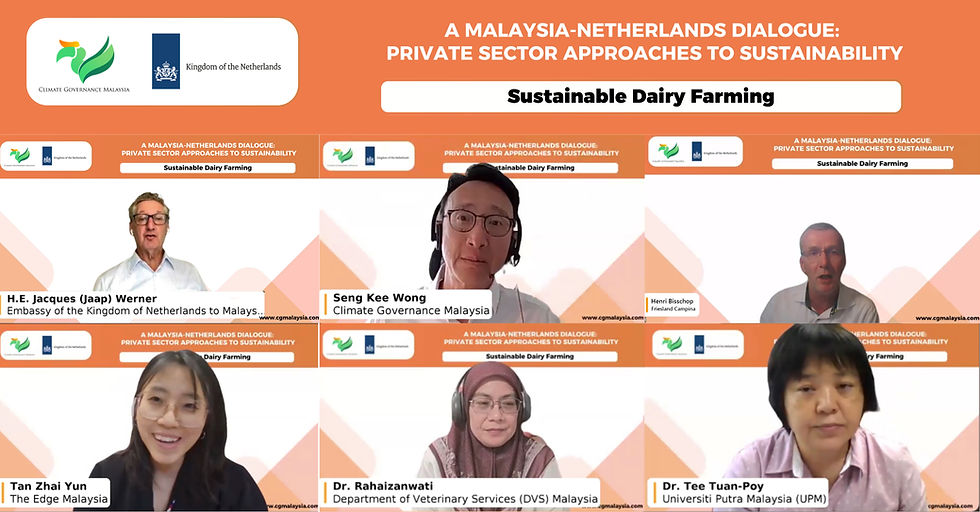
Remarks by:
- His Excellency Jacques (Jaap) Werner, Ambassador of the Kingdom of the Netherlands to Malaysia
- Seng Kee Wong, CGM, Council Member
Speakers:
- Henri Bisschop, Dairy Development Director Asia, Friesland Campina
- Dr. Rahaizanwati binti Abdul Rahim, Senior Veterinary Officer, Dairy Unit, Ruminant
Section, Livestock Industry Development Division Department of Veterinary Services
(DVS), Malaysia
- Dr. Tee Tuan-Poy Senior Lecturer, Department of Animal Science, Faculty of Agriculture,
Universiti Putra Malaysia
Moderators:
- Tan Zhai Yun (Nat), Editor of ESG, The Edge Malaysia
The third session of the Malaysia-Netherlands Dialogue webinar series convened a plethora of expertise from industry, government and academia to explore the challenges and opportunities of the Malaysian dairy farming industry’s journey, as it transitions to larger and more sustainable operations. Titled “Sustainable Dairy Farming”, it marks the fourth session in a webinar series co-organised by Climate Governance Malaysia (CGM) and the Embassy of the Kingdom of the Netherlands.
His Excellency Ambassador Jaap Werner began the session by emphasising that the shared sustainability challenges for Malaysia’s and the Netherland’s dairy sectors require cross-country collaboration and innovation to solve them. He framed the discussion against what he described as the increasingly scrutinised impact of the industry on food security, the environment and rural livelihoods.
He stressed that it is important to critically assess the environmental footprint of dairy farming and ascertain new methods and technologies to reduce carbon emissions, which is something His Excellency’s government is currently working to address. Offering an ambitious alternative to what he termed a lens of limitation, he closed by underscoring the opportunity for the implementation of sustainable farming practices in Malaysia’s growing dairy sector, using Dutch innovation and experience to guide the journey.
Delivering the welcoming remarks, Seng Kee Wong centred on the relevance of sustainable dairy farming amidst the growing global and national concerns over the security of food systems. Specifically, Wong drew attention to the industry’s impact on Malaysia’s nutrition, land use and emissions management. As the Malaysian industry moves towards a larger scale of dairy production, he emphasised the necessity of building a sustainable, productive and economically viable system that increases agricultural resilience and mitigates negative environmental impacts.
In the keynote address, Henri Bisschop presented the learnings from Friesland Campina’s 30-year-long journey towards sustainable dairy farming, including the aspects of the transition that he deemed crucial to achieving a well-balanced and profitable industry in the Netherlands. He noted that there is a growing demand for dairy in Asia, driven by the need to combat what he described as the triple burden of malnutrition that is prevalent in the region. He pointed to research that shows milk is an unbeatable source of nutrients.
Bisschop then explored the key findings from his organisation’s experience, highlighting the challenges of transitioning without a system-based approach to ensure sustainability is balanced alongside profitability. He discussed Friesland Campina’s sustainable farming model, which prioritises consumer nourishment, incentivising sustainability at the supply-level and producing credible data to drive innovation. He drew attention to the fact that most of the emissions in the dairy sector are produced by farming processes, and argues that Friesland Campina’s record of reducing farming emissions can be leveraged to guide Malaysia’s transition to more sustainable practices.
On the supply-level, Bisschop discussed Friesland Campina’s pro-sustainability drive in more depth. This included focusing on investing in the farming sites themselves, such as planting clovers to boost nitrogen capture and reduce fertilizer reliance, as well as implementing 2,500 data points in every farm to monitor emission. He also stressed the importance of financing the sustainable dairy farming transition, showing how his organisation has accelerated progress by heavily incentivising sustainable farming practices and awarding €280 million last year. He concluded by promoting a system-based approach that places importance on the climate, nature and biodiversity, whilst benefiting the whole dairy farming ecosystem.
Following the keynote, the session moved into a panel discussion moderated by Tan Zhai Yun, bringing together perspectives from government, industry, and academia on how Malaysia can promote a transition to sustainable farming.
Dr. Tee Tuan-Poy opened the panel by presenting research findings on emissions from Malaysia's dairy sector. She highlighted that commercial farms predominantly generate emissions through enteric fermentation and manure management. However, Dr. Tee emphasized that commercial operations have adopted intensive feed management practices that substantially reduce emissions. These farms use total mixed ration systems with approximately 60% concentrate and 40% forage, which improves feed digestibility and reduces methane production. They also employ solid separators and composting systems for manure, enabling waste recycling and even biochar production for carbon credit claims.
With limited capital, smallholder firms rely on open-air manure storage or pond systems, generating significant methane. Dr. Tee suggested that low-cost interventions like covering up manure piles or harnessing simple biogas systems could meaningfully reduce emissions without requiring advanced technology. For bigger commercial farms, feed diets came up as a critical intervention point. Dr. Tee highlighted that using palm kernel cake concentrate as a locally appropriate feed supplement improves digestibility and reduces enteric fermentation. This addresses the constraint that is Malaysia's tropical climate. It produces low-quality forage (due to napier grass, for example) that is poorly suited to high milk production.
Dr. Rahaizanwati outlined the 13th Malaysia Plan's National Dairy Development Program, highlighting genetic improvement as a key strategy. The Department of Veterinary Services has developed a low-probe hybrid dairy cattle breed with high heat tolerance, disease resistance, and strong performance under humid tropical conditions. Through improved and structured genetic breeding programmes, farmers are already adopting this breed, addressing a critical vulnerability as climate change intensifies heat stress on livestock. Dr. Rahaizanwati then spoke of good animal husbandry practices. For almost a decade, government guidelines have emphasised clean milking procedures, equipment sanitation, mastitis control, heat stress mitigation through shade and ventilation, and proper housing design for tropical climates. Finally, she emphasised accredited farm certification, such as the MyGAP (Malaysian Good Agricultural Practice) certification, as a path for farms to gain higher credibility and improved market access.
Notably, Dr. Rahaizanwati highlighted the role that processing companies must play in developing Malaysia’s dairy farming industry. A recent collaboration between the Department and Dutch Lady, which conducted training for approximately 100 local dairy farmers in Port Dickson. The session attracted a notably younger cohort of farmers, suggesting growing interest in the sector among the next generation. She also argued that fair pricing for the sale of raw milk to processing companies is a critical ingredient for the success of smallholder farmers. This guarantees economic resilience and enables sustainable production through financial stability and long-term planning.
Bisschop similarly discussed the importance of responsible milk procurement and a level playing field for all actors within the industry. He highlighted the need for both high-quality milk, in terms of protein, hygiene and fat, but stressed that this must be balanced with a high sustainability standard and urged for a strengthening of sourcing requirements on the part of processing companies. He then reiterated the central thesis of his keynote address; that a system-based approach is crucial to ensure an industry-wide shift towards sustainability. He emphasised that the dairy market has to be both competitive but equal in terms of quality, sustainability and pricing.
A major theme that came up as the panelists began to conclude their session was the importance of economic resilience for the dairy farming industry in Malaysia. Both Bisschop and Dr. Tee concurred that financial support and incentives from government, institutions and businesses for small-scale farmers is key to unlock capital. They also highlighted the emergence of ESG-focused banks and Government-Linked Companies (GLCs) as viable partners for successful farmers seeking to expand into larger operations. Dr. Rahaizanwati also emphasised the government’s national dairy development funding for small and large scale farms as an example of indirect financial support that can release capital. Dr. Rahaizanwati and Bisschop stressed that industrial purchasers of raw milk have a responsibility to provide purchase continuity and fair pricing, so that smaller farmers are not vulnerable to market instability.
The session provided a thorough outlook on the future of Malaysia’s dairy farming industry and how it can best chart its course towards sustainability. Through the keynote address and panel discussion, participants gained a deeper understanding that sustainable dairy farming will impact more than the environment - the economy, food security and rural livelihoods of Malaysia will be affected as well. Thus, the session highlighted a diverse range of challenges and solutions, to ensure the transition takes into account these different areas.
Click here to read the full Q&A
Click here to watch the recording


Comments