.png)
Protecting Critical Freshwater Resources

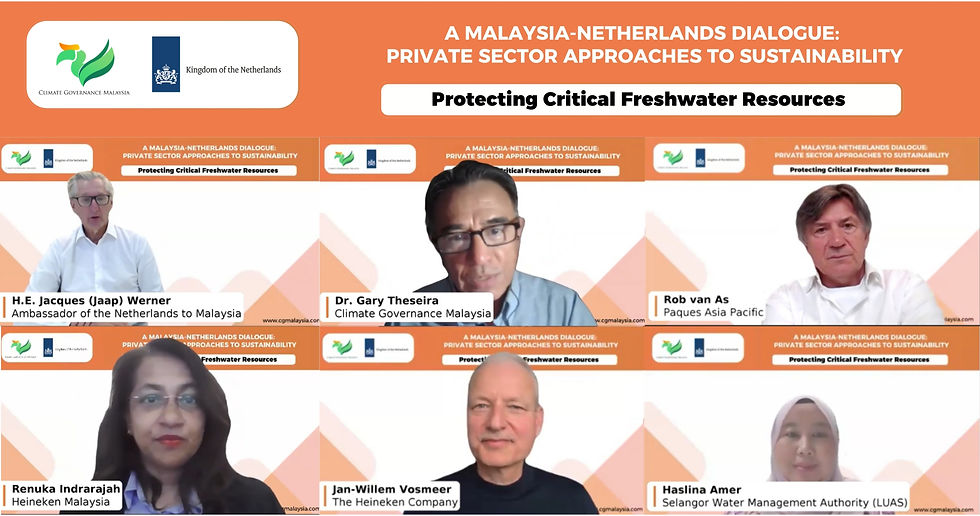
Date: 31 March 2026
Protecting Critical Freshwater Resources
Remarks by:
His Excellency Jacques (Jaap) Werner, Ambassador of the Kingdom of the Netherlands to Malaysia
Dr. Gary Theseira, CGM, Chair of the Council
Speakers:
Rob van As, Managing Director, Paques Asia Pacific
Jan-Willem Vosmeer, Corporate Social Responsibility Manager & Global Corporate Relations, The Heineken Company
Haslina Binti Amer, Chief Assistant Director and Head of River Basin and Coastal Management Division, Selangor Water Management Authority (LUAS)
Moderator:
Renuka Indrarajah (Corporate Affairs & Legal Director, Heineken Malaysia)
The webinar convened practitioners from industry, government, and the private sector to examine the growing pressures on freshwater resources in Malaysia and globally, and the collective responsibility of businesses, regulators, and communities to act. Titled "Protecting Critical Freshwater Resources," it marked the first session in a webinar series co-organised by Climate Governance Malaysia (CGM) and the Embassy of the Kingdom of the Netherlands.
His Excellency Ambassador Jaap Werner opened the session by situating it within a broader series that will address legal and litigation aspects of climate change, renewables, agriculture, and carbon markets in the coming months. He framed the discussion against what he described as a triple planetary crisis: climate change, biodiversity loss, and environmental pollution, driven by unsustainable production, overexploitation of natural resources, and land use change.
He stressed that the private sector is equally critical as governments in driving the sustainable transition. Invoking the Netherlands' principle of solving global challenges together, he closed by underscoring the significance of the day's topic, describing water as the single most important item that decides life on this planet.
Delivering the welcoming remarks, Dr. Gary Theseira, framed the urgency of the discussion by drawing on Malaysia's increasingly volatile weather patterns. He noted the simultaneous occurrence of three typhoons in the region in late 2024 and the mounting threat of a strong El Nino cycle, which had already left rice farmers in Kedah and Perak without sufficient water to begin planting, while parts of Sabah had been declared drought disaster areas. His remarks challenged a long-held assumption: that Malaysia's abundant rainfall insulates it from the water crises facing other parts of the world.
In the keynote address, Rob van As, offered an overview of the pressures on Malaysia's freshwater resources and the technologies available to address industrial pollution. He noted that while Malaysia receives around 900 billion cubic metres of rainfall annually, with rivers serving as the primary source of supply, as much as 35% of treated water is lost through aging and leaking municipal infrastructure before it ever reaches consumers.
On the industrial side, he identified palm oil mills, pulp and paper, chemicals, and textiles as the most significant polluters, noting that conventional low-rate treatment systems including open ponds and covered lagoons are largely inadequate. He made the case for high-rate anaerobic reactor systems, developed on the back of research from Dutch universities including Delft and Wageningen, which convert organic waste into biogas while producing minimal sludge and consuming no net energy.
Rob highlighted case studies from across Malaysia, including a project at Central Sugar Refinery in Port Klang and a palm oil mill facility in Pahang, and noted that Paques' global portfolio now treats more than 7,500 million kilograms of organic pollution annually. He also pointed to a persistent gap between the existence of sound environmental regulations and their consistent enforcement, particularly in facilities located away from urban centres, arguing that closing this gap would alone represent a significant leap forward in protecting Malaysia's waterways.
Following the keynote, the session moved into a panel discussion moderated by Renuka Indrarajah, bringing together perspectives from government, industry, and technology on how Malaysia can strengthen its approach to freshwater protection.
Haslina Binti Amer, provided the regulatory and institutional perspective. She outlined the Lembaga Urus Air Selangor (LUAS)'s mandate to safeguard both the quantity and quality of water resources across Selangor's seven major river basins, which supply water to Selangor, Kuala Lumpur, and Putrajaya. She described a layered governance structure that combines 24-hour on-site monitoring, telemetry-based water quality stations, and a licensing regime covering all water extraction and discharge activities. Of particular note was LUAS's Zero Discharge Policy (ZDP), gazetted in 2024 and the first of its kind in Malaysia, which requires all premises to recycle and reuse their effluent rather than discharge it into waterways.
Haslina also highlighted the Selangor Water Assurance Scheme, developed in response to repeated supply disruptions during the COVID-19 period, as well as a pipeline of pond-based storage infrastructure and a hybrid river augmentation scheme with a capacity of 3,000 million litres per day. She emphasised that enforcement alone is insufficient and that LUAS actively engages industries through consultation, site visits, and its community-facing Friends of River programme to build genuine awareness of where tap water originates and why river health matters. As she put it, the river running behind a factory may well be the same source flowing out of the taps inside it.
Jan-Willem Vosmeer, shared the global journey of a major corporate actor working to embed water stewardship across its entire value chain. He noted that Heineken has been tracking and reporting on water use since 1994, and has reduced its water intensity from over 10 litres per litre of beer to 2.9 litres by 2025, achieving its target five years ahead of schedule and saving 4.2 billion litres in the process. A new target of 2.6 litres per litre globally and 2.4 litres in water-stressed areas has been set for 2030. Jan-Willem stressed, however, that operational efficiency is not sufficient: even the most water-efficient brewery remains dependent on a healthy watershed.
Heineken's current strategy therefore extends beyond factory gates to encompass watershed replenishment, community water access, and engagement with farmers on irrigation and soil health. He cited examples from Spain, Mexico, Vietnam, and Ethiopia, and noted that as of 2025, replenishment projects are active at 38 of the company's 40 priority sites in water-stressed areas, with 43% of those breweries now fully water-balanced. He concluded by identifying water risk as a business risk, urging that it be treated as a boardroom-level leadership issue rather than an operational afterthought.
The panel discussion drew together the threads raised across all three presentations. Rob and Haslina both noted that regulatory compliance in Malaysia tends to correlate with proximity to urban centres, with more remote facilities operating with far less oversight, pointing to the need for more consistent and far-reaching enforcement. Rob also highlighted the role that financing instruments can play in accelerating progress, citing the Netherlands' Invest International scheme as an example of public-private support that helps enterprises design and deploy sustainable wastewater solutions. The conversation kept returning to the limits of what any single actor can achieve in isolation, with Jan-Willem and Renuka both stressing that meaningful progress depends on governments, industries, and communities aligning around common priorities at the basin level rather than pursuing fragmented, facility-by-facility improvements.
Closing the discussion, each panellist offered a final takeaway. Haslina called for a broader recognition that water must be protected for the environment and ecosystems as much as for economic and domestic use. Rob reiterated the importance of financing as an enabler of change. Jan-Willem emphasised that resilience is only ever built locally and collectively. Renuka synthesised these threads by observing that investments in water stewardship are not simply a response to immediate scarcity but a long-term commitment to economic resilience and community wellbeing.
The session closed with a significant announcement from His Excellency Ambassador Jaap Wemer, who confirmed that a Memorandum of Understanding on water cooperation between the Netherlands and Malaysia would be signed the following week with the Deputy Prime Minister, covering flood management, wastewater treatment, drinking water, and irrigation. The Ambassador expressed the Netherlands' ambition to become Malaysia's preferred strategic water partner, with scope for state-level arrangements with Selangor and Sarawak. He framed the MOU not as an end in itself but as a foundation for meaningful collaboration between government agencies, businesses, and research institutions on both sides.
The session set a strong tone for the webinar series ahead. Across all contributions, a consistent message emerged: Malaysia's water challenge is not simply one of scarcity or pollution in isolation, but a systemic issue requiring coordinated action across regulation, technology, finance, and community engagement.
Please kindly click the this link to access the presentation slides of the webinar
Click here to watch the recording

Wonderful dialogue to highlight — the Malaysia-Netherlands exchange on private sector sustainability approaches demonstrates how cross-border collaboration is becoming essential for protecting critical frameworks that markets alone cannot safeguard. Institutional investors engaging with these conversations are drawn to a think tank workshop for institutional investors seminar & course in Amsterdam, Netherlands — where sustainability strategy and impact-driven investment thinking are explored at the highest level.