.png)
Palm Waste as Valuable Biomass

Date: 14 May 2026
Remarks by:
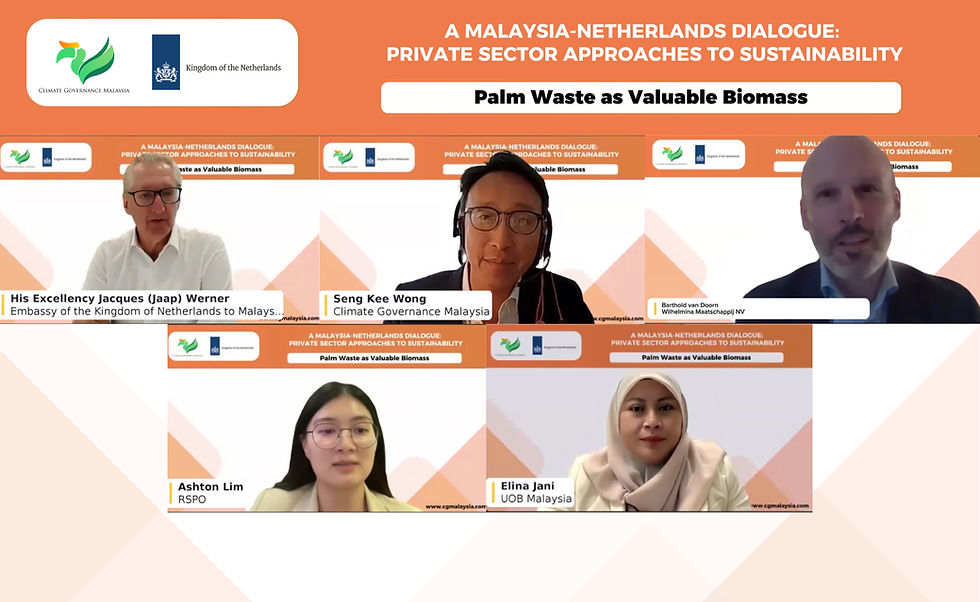
His Excellency Jacques (Jaap) Werner, Ambassador of the Kingdom of the Netherlands to Malaysia
Seng Kee Wong, Council Member, Climate Governance Malaysia
Keynote Speaker
Barthold van Doorn, Chief Executive Officer and Co-Founder, Wilhelmina Maatschappij NV
Panelists:
Barthold van Doorn, Chief Executive Officer and Co-Founder, Wilhelmina Maatschappij NV
Elina Jani, Senior Vice President, Country Sustainability Office, UOB Malaysia
Professor Dato' Dr Ahmad Bin Ibrahim, Fellow, Tan Sri Omar Centre for STI Policy Studies, UCSI University, Adjunct Professor, Ungku Aziz Centre for Development Studies, Universiti Malaya.
Moderator:
Ashton Lim, Manager, Climate Change, GHG, Roundtable of Sustainable Palm Oil (RSPO)
The webinar convened practitioners from technology, corporate, academia, and the private sector to examine Malaysia’s substantial but underutilised palm oil biomass waste streams, and the collective action required from industry, government, and capital markets to convert those residues into viable fuels, chemicals, and circular economy assets. Titled “Palm Waste as Valuable Biomass,” it marked the third session in the webinar series co-organised by Climate Governance Malaysia and the Embassy of the Kingdom of the Netherlands.
His Excellency Ambassador Jacques Werner delivered the opening remarks, aligning the session with the established sustainability dialogue between Malaysia and the Netherlands. He noted that Malaysia is one of the world’s leading palm oil producers and that the Netherlands is the largest Malaysian palm oil importer in the European Union, framing the bilateral relationship as both commercially significant and strategically positioned to drive circular solutions. He highlighted that empty fruit bunches alone generate approximately 19 million tonnes of agricultural waste per year in Malaysia, a waste stream that, if left to decay, could produce as much as 12 million tonnes of methane, equivalent to 300 million tonnes of CO₂. He called on participants to look beyond short-term outputs toward long-term resilience, stressing that the transition to sustainable biomass solutions cannot be achieved by one sector or one country alone.
Delivering the welcoming remarks, Seng Kee Wong, added further context to the scale of the opportunity. He noted that Malaysia produced 20.28 million tonnes of crude palm oil last year, the first time the country has crossed the 20 million tonne threshold, generating substantial volumes of empty fruit bunches, palm oil mill effluent, palm kernel shells, and other residues. He flagged the looming implications of fertiliser supply disruptions as an additional argument for developing biofertiliser applications from palm waste. He also announced the registration of Malaysia’s first project under the Verified Carbon Standard (VCS) Program, managed by Verra, a global nonprofit organisation that develops internationally recognised standards and certification programmes for climate action, carbon markets, sustainable development, and environmental projects was launched on 4 May 2026. This national-scale initiative integrates multiple sites and technologies under a unified framework to convert underutilised biomass into renewable energy, while creating a significant new revenue stream for the sector.
In the keynote presentation, Barthold van Doorn, framed the central challenge as one of unlocking: palm biomass is abundant and represents a compelling environmental and energy security opportunity, but its high contamination levels including potassium and chlorine and low biodigestibility make direct conversion into fuel impractical without pre-treatment. He described the company’s proprietary TG2 process, which combines steam explosion technology from the pulp and paper industry with a bespoke pre and post-treatment system to remove contaminants, increase porosity and bioavailability, and standardise diverse biomass inputs including empty fruit bunches, palm oil mill effluent (POME) sludge, and decanter cake into a stable precursor powder suitable for multiple downstream applications. These range from densified pellets and coal binders for co-firing at power plants, through enhanced digestion to biogas, bio-CNG, and sustainable aviation fuel feedstocks, up to carbonisation for biochar and biocoal, and gasification to produce syngas and biochemicals. Barthold emphasised that the process is designed to utilise every component of the empty fruit bunch rather than cherry-picking easier fractions, enabling palm oil mills to move toward near-zero discharge operations. He pointed to a demo-scale plant built in Malaysia, from which samples were shipped to Japan and successfully stored for 30 days in a coal yard before being co-fired at a coal power plant as a drop in replacement for coal, the first validation of its kind.
Following the keynote, the session moved into a panel discussion moderated by Ashton Lim. Elina Jani, outlined the growing commercial potential of Malaysia’s biomass sector. She noted that industry growth is being driven by stricter energy mandates, sustainability frameworks such as the Malaysian Sustainable Palm Oil (MSPO) and RSPO, and a global biomass fuel market projected to reach US$ 2.6 billion by 2032. She highlighted key factors for bankable projects, including secure feedstock supply, utility integration, and efficient biomass processing, while also identifying major investment barriers such as fragmented supply chains, limited verified biomass data, and ESG-related restrictions on palm linked investments. Elina further noted the disconnect between public sector priorities focused on national sustainability goals and private sector concerns centred on profitability, financial returns, and risk management.
Prof. Dato’ Dr. Ahmad bin Ibrahim offered the academic and policy perspective, noting that palm fronds cut alongside each fruit bunch at harvest represent an even larger volume of biomass than empty fruit bunches themselves, yet remain almost entirely uncollected due to the absence of viable collection and logistics infrastructure. He argued that Malaysia’s successive biomass policy frameworks have not translated into a properly coordinated industry driver, and called for the establishment of a dedicated governance body analogous to the Malaysian Palm Oil Board to bring together industry, government, academia, and civil society around biomass circularity. He was pointed in his assessment of the palm oil industry itself: with palm oil currently commanding strong prices and profits, there is limited commercial incentive for mills to voluntarily invest in what they perceive as additional complexity. A different set of investors and a different institutional catalyst is needed. He also broadened the value framing beyond energy, noting that unlocking biomass value chains could provide direct economic benefits to smallholders who currently receive no compensation for the biomass fraction of their harvest, and that sustainability must ultimately be measured in terms of return of value to communities and rural economies, not merely return on investment.
The panel discussion drew together the threads raised across all three contributions. Van Doorn, highlighted that major technology risks have been reduced through industry validation and successful co-firing trials in Japan, strengthening investor confidence. He noted that key challenges remain in logistics, sustainability verification, and smallholder inclusion, but said integrated business models that manage palm oil mill waste in exchange for long term feedstock access are helping address these issues. On carbon financing, he explained that viable carbon credit methodologies are still developing, with mechanisms such as Article 6 and the Joint Credit Mechanism seen as the most promising pathways. Elina added that carbon capture, utilisation, and storage technologies could unlock new revenue streams through products such as green methanol and food grade CO₂. Meanwhile, Prof. Dato’ Dr. Ahmad noted that Malaysia’s Ministry of Economy is finalising a National Framework on Circular Economy to improve cross ministerial coordination and strengthen national implementation.
Closing the discussion, each panellist offered a final takeaway. Van Doorn emphasised the scale of the opportunity and the need for technology, funding, and policy to converge as a collective effort. Elina called for a fundamental reframing: palm waste should be treated not as a cheap agricultural by-product but as a premium contract-structured asset, with the private sector replacing volatile spot market relationships with long term, legally binding take or pay supply agreements matched to sovereign grade offtake contracts. Prof. Dato’ Dr. Ahmad endorsed both positions, underscoring that the governance ecosystem required to make this transition real remains the most urgent gap to fill, and that the driver must come from outside the palm oil industry itself.
The session set a substantive tone for the series ahead. Across all contributions, a consistent message emerged, Malaysia holds a genuinely large and underexploited biomass resource, the technology to unlock it has now been demonstrated at scale, and global market and policy signals are aligning. The scaling bottleneck is no longer primarily technical. It lies in supply chain contract architecture, cross ministry governance, verified data infrastructure, and the financial re-engineering needed to transform an abundant but fragmented feedstock into a bankable institutional asset class.
Please kindly click the this link to access the presentation slides of the webinar
Click here to watch the recording

Comments