.png)
Lessons from 2025 and the need to accelerate national, regional and global climate action in 2026


In June of 2025, the IFRS Foundation formally recognised Malaysia as the only ASEAN jurisdiction adopting ISSB Standards with limited transition — a major milestone, made possible through the development, adoption and implementation of the National Sustainability Reporting Framework (NSRF). This global acknowledgment highlighted Malaysia’s alignment with ISSB’s IFRS S1 & S2 standards, the adoption of climate-first reporting with phased Scope 3 disclosures, and finally, supportive initiatives like Policy, Assumptions, Calculators and Education (PACE), to build industry readiness.
In early December, the Joint Committee on Climate Change (JC3) launched the Sustainable and Transition Finance Guidance. This guidance document, developed by an industry-led Working Group with members from Maybank, CIMB and HSBC Amanah, and supported by Bank Negara Malaysia (BNM) and Securities Commission Malaysia (SC), sets out the key principles that banks can follow and use to assess borrowers, at both the asset and entity levels, when providing financing to the real economy.
These developments have set the stage for the submission of NSRF reports of the first group (Public listed companies with market capitalization at or over rm200 billion) before the end of 2026; a key milestone in Malaysia’s sustainability transition, and, in many ways, a test of the effectiveness of the industry-regulator platform approach to corporate regulation.
In terms of climate impacts, the Neutral El Niño Southern Oscillation (ENSO) to mild La Niña conditions were, for the most part, kind to Malaysia and most of the Maritime Continent in general (the notable exception being the Philippines). Throughout the northern hemisphere Summer, the Philippines, Taiwan, Vietnam, China and Even Japan, were more or less regularly pummeled by tropical cyclones and tropical storms of various strengths (see illustration of tropical cyclone tracks for 2025 – storm tracks are from the Japan Meteorological Agency - JMA, and the diagram produced by WesternPacificWeather.com). A fair proportion of these storms even exited the tropical region, continuing into the mid-latitudes of the North Pacific and becoming Extra-tropical Storms.
It was late November, before the global climate system decided to see the year out on its own terms. In the closing week of November, the strong La Nina conditions (warm surface sea temperatures (SSTs) in the western Pacific, coupled with a negative Indian Ocean Dipole (warm SSTs in the eastern Indian Ocean) spawned three simultaneous cyclonic storms, one each in the Indian Ocean, the Straits of Melaka and the South China Sea (covered in my previous Memo).

Hardest hit were Indonesia, Sri Lanka, Vietnam, Thailand, and Malaysia, with numerous lives lost to landslides and flooding. Of the three cyclonic storms referred to above, the most unexpected was Tropical Storm Senyar, visible as the short green (tropical storm) and blue (tropical depression) c- shaped track in the far lower left of the map above, far outside the normal geographic range of tropical cyclones, and the first ever tropical storm to be recorded as forming in the narrow and sheltered Straits of Melaka. Despite its short five-day life, it brought as much as a month’s worth of rain in just two days, to some parts of the region, causing deadly landslides and catastrophic flooding in Northern Sumatera, Southern Thailand and Peninsular Malaysia.
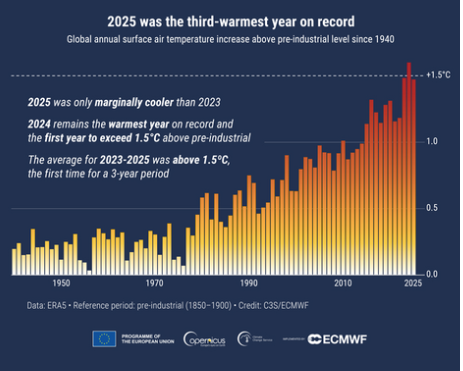
The global average temperature in 2025, was marginally cooler than in 2023 or 2024, the warmest year on record, according to data by Copernicus (below), nevertheless, the most recent three year average has exceeded 1.5 degrees Centigrade, another historical first.
And we already see that the accumulation of heat by the major water bodies in our region, the Andaman Sea, the Indian Ocean, the South China Sea, the Straits of Melaka, and the Pacific, can already produce the kind of extreme weather not historically associated with the Maritime Continent, which countries in the region might not be prepared to manage.
Finally, this year marks a crucial milestone for Malaysia as we plan to complete the National Adaptation Plan (NAP) and the Long-term Low-emissions Development Strategy (LT-LEDS), both of which require a highly strategic approach to planning for future climate scenarios.
In next week’s memo, I plan to examine the curious findings of the Global Risk Perceptions Survey (GRPS), reported in the World Economic Forum’s Global Risk Report (GRR 2026), which found that, among other things, heightened prioritization of non-environmental risks relative to environmental ones compared to previous years. According to the GRPS, in the outlook for the next two years, a majority of environmental risks experienced declines in ranking, with Extreme weather events moving from #2 to #4 and Pollution from #6 to #9. Critical change to earth systems and Biodiversity loss and ecosystem collapse also declined, by seven and five positions, respectively, and are in the lower half of the risk list this year in the two-year outlook.
At a time when environmental-related losses continue to mount from year to year, and constitute an enormous burden on developing economies, this shift in prioritization raises concerns that vulnerable countries could be deemphasizing climate impacts to bolster investor confidence – something that, for want of a better term, could be called ‘risk hushing’.


Comments