.png)
Lack of Rainfall vs. High Temperatures: What Is Driving the Growing Global Incidence of Drought?


This is an important point because it reflects a sea change in our understanding of what causes droughts. As the image (left) explains, between 1949 and 1999, droughts in the Western United States were caused mostly by a lack of rain (or snow), and only very rarely, in the states of Texas, New Mexico, Colorado, and Wyoming, by high temperatures. Since 2000, on the other hand, we see that apart from a coastal belt running from Western Washington State in the Northwest, South through Western Oregon, and through California, which saw lack of rain as the primary cause of drought, the bulk of the Southwestern and Rocky Mountain States, as well as the Midwestern States east of the Rockies, experienced drought, not due to lack of rainfall, but due to high temperature-driven evaporation.
The implications of this are stark! Extreme heat can cause droughts to occur even if an area receives the usual, or normal, amount of rainfall, because heatwaves will increase the rates of evaporation (from soil) and evapotranspiration (from plants), to rates greater than what normal seasonal rainfall provides. Because of this, soil water reserves are exhausted more quickly and if not replenished or supplemented by other sources, will give rise to drought conditions. Given the prospect of water shortages in the entire Western United States, it is unsurprising, therefore, that the US President is setting the stage for acquiring large volumes of water from Canada.
Commentators on this topic have cited President Trumps reference to a “very large faucet” in Canada, or to his allegations that California Governor Gavin Newsome was somehow to blame for the lack of water to put out the California wildfires, because during President Trump’s first term, he (Governor Newsome) didn’t accept "the water coming from the north." "From way up in Canada, and you know, the north. It flows down right through Los Angeles… Massive amounts coming out from the mountains, from the melts," as the President put it. To all this, Canadian Prime Minister Mark Carney’s response was a polite, but firm “No.”
This concern over water resources becomes clearer when we understand the nature of water on our planet. If all the water on earth were proportionately equal to a standard bathtub (26 gallons or very nearly 100 litres), only a half of a teaspoon (2.5ml), would be fresh water. Everything else is at least as salty as seawater and undrinkable. Yes, of all the water on earth, only 0.0026% is fresh water. Yet, this two and a half teaspoons accounts for all the ponds, freshwater lakes, rivers, irrigation and drainage canals, dams, reservoirs, and the entire potable water production and distribution system in the world.
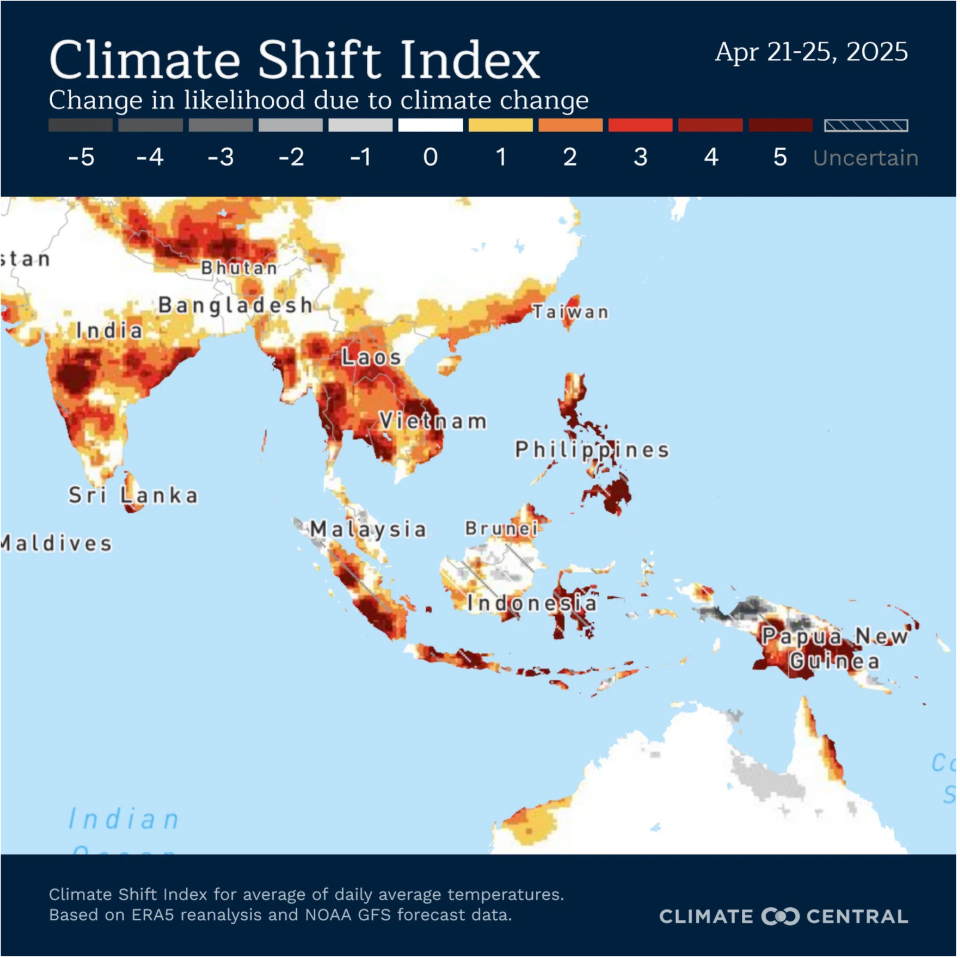
I raise this point because I believe that the warming we see happening in the US is also happening here in Asia. This is particularly so in Southeast Asia, where we keep a close watch on the status of the El Niño Southern Oscillation (ENSO), in the general belief that localized and regional rainfall and temperature conditions are strongly shaped by these cyclical phenomena. What has become evident in recent months is that high temperature anomalies (shown to the left) all occurred during ENSO-neutral and even marginal La Niña ENSO phases . Although el Niño conditions ended around April of 2024, the 2025 rash of heatwaves began in Indonesia at the end of 2024, followed throughout 2025 by heatwaves in the Philippines, Myanmar, Thailand, Vietnam, India and Pakistan, all during an ENSO-neutral phase.
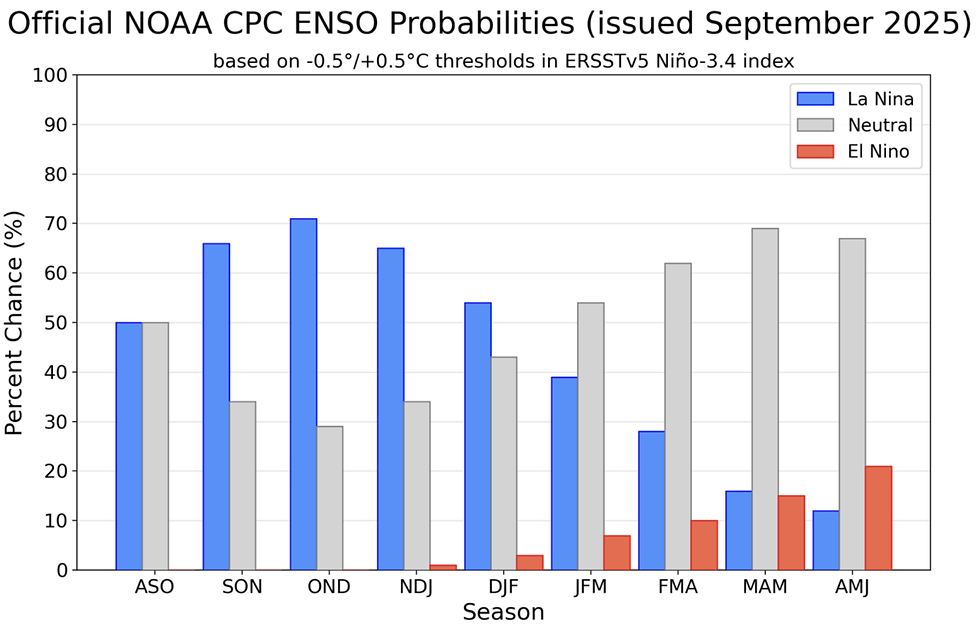
As September gives way to October, we see from the NOAA, CPC ENSO Probabilities (right) that the remainder of 2025 is anticipated to favour La Niña conditions (blue bars), giving way to the probability for ENSO-neutral conditions (grey bars) for the first half of 2026, with an initially, unlikely, but growing probability for El Niño conditions (red bars) as 2026 progresses. If high temperatures and even heatwaves become the hallmark of ENSO-neutral conditions, we will need to be doubly prepared for the heatwave conditions that would coincide with the reduced rainfall and dry conditions associated with El Nino conditions and the severe drought that could follow.


Comments