.png)
Part III of Synergising Foreign Investor and State Climate Priorities.

Updated: Jan 16
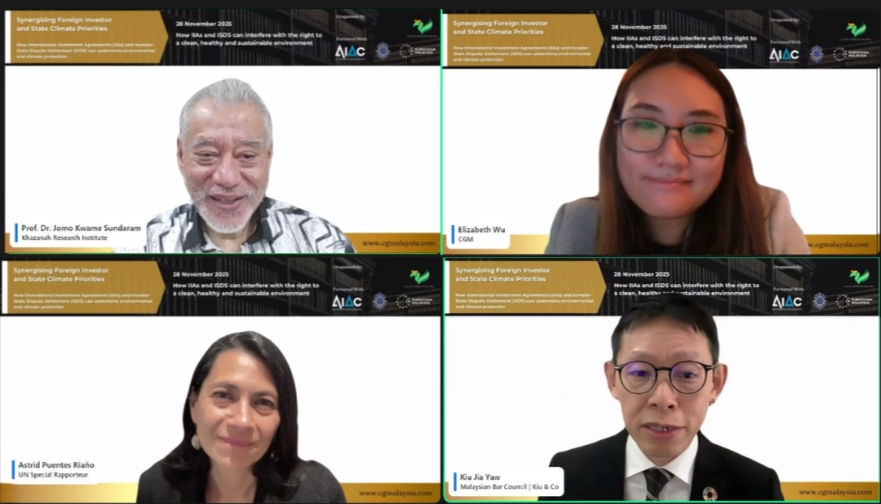
"How IIAs and ISDS can interfere with the right to a clean, healthy and sustainable environment"
Date: 28 November 2025
Speakers:
Prof. Dr. Jomo Kwame Sundaram, Research Advisor, Khazanah Research Institute
Kiu Jia Yaw, Chair, Bar Council Environment & Climate Change Committee; Sustainability Lawyer, Kiu & Co.
Astrid Puentes Riaño, UN Special Rapporteur.
Moderator:
Elizabeth Wu, Lead Advisor, Environmental Justice and Transnational Governance, Climate Governance Malaysia
In this final instalment of the three-part webinar series, the session examined how international investment agreements (IIAs) and investor–state dispute settlement (ISDS) mechanisms influence and at times limit governments’ ability to fulfil their environmental and climate commitments. The session further unpacked the real-world implications for public policy, environmental protection, and the global push for a just transition, highlighting the growing tension between investment protection and the fundamental right to a healthy environment.
UN Special Rapporteur Astrid Puentes Riaño opened the discussion by highlighting that 165 states now recognise the right to a clean, healthy, and sustainable environment as a fundamental human right, encompassing clean air, a safe climate, water, biodiversity, and procedural rights such as public participation, access to information, and access to justice. She noted that this right is increasingly viewed as customary international law and can be enforced in court, citing the La Oroya vs Peru case as a landmark example. She further explained that Advisory Opinions from both the ICJ and IACHR impose a stringent due diligence obligation on states, with the ICJ explicitly affirming that a healthy environment is a precondition for all other human rights.
Turning to IIAs, Special Rapporteur Astrid stressed that contemporary investment treaties often prioritise investor protections at the expense of environmental regulation, resulting in a global pattern where fossil fuel and extractive companies challenge legitimate climate measures. This has produced costly litigation and a pervasive regulatory chill, discouraging states including Malaysia from enacting stronger protections. She also pointed out the structural injustice of ISDS processes, which are often confidential, handled by private arbitrators, and exclude affected communities, undermining transparency and the procedural rights necessary for environmental justice.
Adding a broader political and economic lens, Professor Jomo argued that investment law and multilateral processes remain fundamentally misaligned with environmental and human rights needs. He highlighted the dominance of property and investor rights over human rights in the current legal order, and explained that even the United States; withdrew from the Trans-Pacific Partnership citing concerns about ISDS undermining US sovereignty. Regionally, he warned that Malaysia and ASEAN face added vulnerability because most ASEAN investment treaties lack environmental and human rights safeguards, reinforcing the urgency of reform at both bilateral and plurilateral levels.
From a national legal perspective, Jia Yaw explained that the Malaysian Bar Council is advocating for constitutional recognition of the right to a clean and healthy environment and pushing to modernise Malaysia’s IIAs with strong environmental and climate safeguards to protect national sovereignty. He emphasised the need to preserve the state’s right to regulate in the public interest, especially as Malaysia navigates its energy transition as an oil-producing nation. He also highlighted the Bar Council’s ongoing work in capacity-building for lawyers, improving public accountability in ISDS, and strengthening civil society participation reflecting the broader role of civil society as a driver of environmental justice and government accountability.
As the discussion turned to solutions, the panel agreed that systemic change, rather than incremental reform, is essential. Special Rapporteur Astrid emphasised the need for persistence, creativity, and collaboration across borders and generations, noting that meaningful climate progress requires intergenerational leadership and cross-sector partnerships that align trade rules with human rights and climate science. She reminded participants that civil society plays a critical role in shaping policy momentum and must continue advocating despite institutional constraints. Professor Jomo reinforced this by warning against short-term political deals and urging strategies grounded in geopolitical realities.
The session concluded with consensus that advancing climate and environmental justice will require governments, legal institutions, civil society, and international bodies to work collectively to ensure investment law supports, rather than undermines, the transition to a sustainable future.
Click here to watch the recording


Comments