.png)
Episode 7 of the Nuclear Webinar Series: Natural Uranium, National Independence -The Canadian Expertise

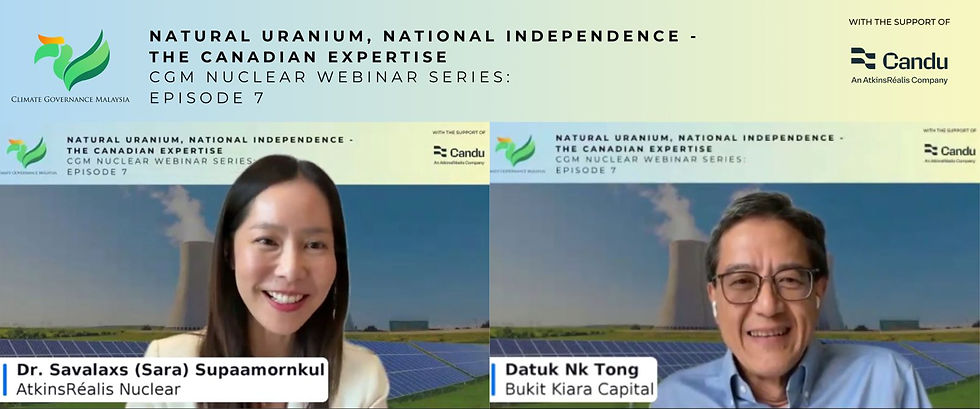
Speaker: Dr. Savalaxs (Sara) Supaamornkul, Director of International Business Development at Candu Energy Inc, an AtkinsRéalis Company
Moderator: Datuk NK Tong, Public Advocate for Nuclear Energy
Episode 7 of the Nuclear Webinar Series brought together Dr. Sara Supaamornkul of AtkinsRéalis Nuclear Canada and moderator Datuk NK Tong to explore the CANDU Pressurized Heavy Water Reactor (PHWR), presenting it as the third most common nuclear technology globally. It serves as a purpose-built reactor technology for the modern energy transition. The presentation referenced the pledge to triple global nuclear capacity, a goal endorsed by COP28 and increasingly recognised as essential to climate resilience.
Dr. Sara argued that CANDU reactors provide reliable low-carbon baseload electricity, supporting long-term decarbonisation efforts. With a levelised cost of electricity of approximately 10 Canadian cents (RM0.29) per kilowatt hour, they are highly competitive with other low-carbon technologies. Their superior capacity factors exceeding 95% support stable baseload electricity generation for around 90–100 years with refurbishment, making them indispensable in the clean energy transition. CANDU reactors currently produce 50% of the world's supply of Cobalt-60, which is used to sterilize 40% of the world's single use medical devices.
A central theme of Dr. Sara’s presentation was CANDU’s identity as a reactor designed from inception specifically as a power generation platform. This distinction, she argued, gives CANDU inherent advantages that persist throughout its operational life. With a proven track record of on time, on budget megaproject delivery spanning eight decades, CANDU technology has been exported to China, Korea, Romania, Argentina, and other nations, demonstrating its global viability.
A cornerstone of CANDU's competitive advantage is its use of natural uranium fuel, made possible by heavy water's superior neutron economy. Unlike PWRs and BWRs that require uranium enrichment to 3–5%, CANDU operates on natural uranium (0.7% U-235), eliminating dependency on the fourteen countries worldwide that possess enrichment facilities. This positions CANDU as a pathway to genuine energy independence and security for host nations.
Dr. Sara underscored the importance of CANDU’s modular, horizontal pressure-tube design. It features 480 smaller pressure tubes rather than a single large vessel, which allows manufacturing of different parts across host countries, creating local supply chains and economic multiplier effects. In Canada alone, the nuclear sector supports over 250 local suppliers and has generated $12.2 billion in economic benefits within Ontario. Local content can reach as high as 70–80% in Canada and potentially higher elsewhere, depending on host-country industrial capacity.
Beyond electricity generation, Dr. Sara explained that CANDU reactors produce 40% of the world's cobalt-60 and other critical medical isotopes, demonstrating their multipurpose value, particularly through the production of medical isotopes used in healthcare. Furthermore, heavy water acts both as a moderator and a coolant, providing the neutron economy necessary for this flexibility. Dr. Sara explained that heavy water also serves as a permanent equipment asset rather than a consumable cost. It remains in the reactor throughout its operational lifetime.
During the Q&A, Datuk NK and DR. Sara jointly addressed public misconceptions about nuclear safety and waste. Datuk NK drew on previous episodes to note that modern radiophobia is statistically disproportionate, referencing estimates that 8 million people die annually from fossil fuel air pollution. Dr. Sara complemented this by outlining CANDU's defence-in-depth safety architecture. This features independent shutdown systems, multiple containment barriers, and real-time monitoring. Dr. Sara clarified misconceptions about nuclear waste, explaining that radioactive emissions are effectively contained by concrete and steel linings, rendering long-term storage safe and manageable.
Dr. Sara emphasised that nuclear development transcends electricity production; it's capable of elevating technical expertise, nurturing high-skilled workforces, and supporting broader industrial advancement. South Korea's transformation from post-war poverty to technological leadership, driven by a deliberate strategy to use nuclear energy to nurture high-skill engineering talent, was cited as the clearest evidence of what is possible.
The session concluded with a shared call to action for Southeast Asia. With approximately 80% of the world's countries still without nuclear power, Dr. Sara and Datuk NK Tong emphasised that the window for early mover advantage remains open, but not indefinitely. Countries that move decisively on nuclear now stand to capture energy security, industrial capability, and technical leadership. Those that wait risk surrendering that ground to others, and with it, the broader economic benefits that a hundred- ear energy infrastructure commitment makes possible.
Click here to watch the recording

Comments